
Internal prototype
Octops
An operating environment for small ecommerce teams, connecting business context, useful tools and owner authority.
- My part
- Set the product direction and requirements, shaped the interactions, and developed and evaluated the prototype with AI agents.
- Where it stands
- An internal prototype built on OpenBot, with a Shopify connector and bounded demo-store tests. The complete proposal-and-approval loop is still ahead.
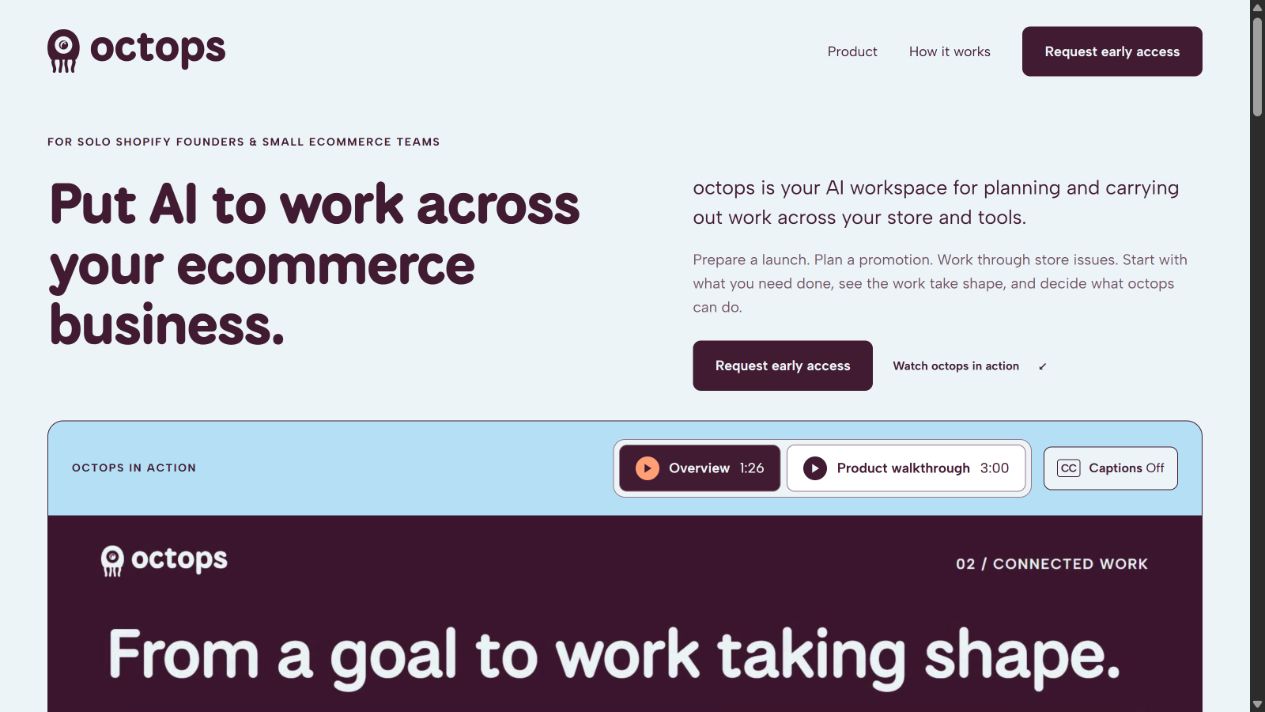
I’m building Octops around a question: what would it take for AI to understand the business it is helping with? For a small ecommerce team, inventory, orders, policies and everyday decisions belong to the same picture, even when the tools keep them apart.
The work has moved from research and product direction into an internal prototype. Built on CopilotKit’s OpenBot, it includes a Shopify connector and a store connection flow. I’m developing it with AI agents, working through how business context, tool access and owner authority fit together.
Start with the business
My Shopify experience gives me a practical starting point: a technical question often belongs to a wider workflow. Connecting another tool is useful when it helps someone understand or do the work in front of them.
Octops explores an integrated environment for that work. The companion is one way into it; the context and capabilities behind it need to remain inspectable.
From a question to something testable
The prototype connects through Shopify’s Admin GraphQL API and per-store OAuth. Project testing records include reads against a demo store and a connection rehearsal. These are bounded integration results, not evidence that a whole business can run autonomously.
Direction, reuse and implementation
My contribution spans the product direction, requirements, interaction decisions, agent-assisted implementation and evaluation. The foundation reuses OpenBot, and the connector also draws on open-source work.
An answer, a proposal and permission to act need to mean different things. I want the owner to be able to inspect what the system knows, understand what it proposes and decide what it may change.
What comes next
I want to work through a complete business proposal-and-approval loop. There’s more to do on context and connected workflows before putting Octops in customers’ hands.
The loop I’m working toward
A product direction, not a claim that the complete loop is implemented.
Understand
Bring relevant business context and connected information into view.
Propose
Make the intended change and its reasons inspectable.
Authorize
Let the owner decide what may happen.
Observe
Check the actual result and carry useful context forward.